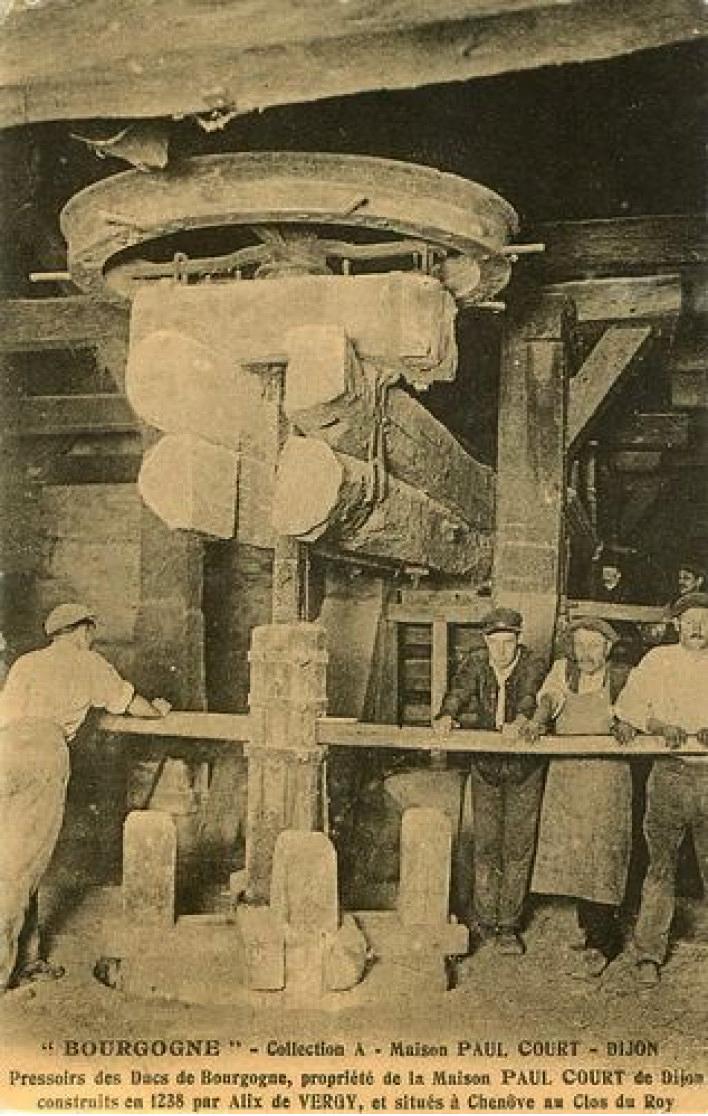
9 - The wine presses of the Dukes of Burgundy
In the Middle Ages, the Dukes of Burgundy cultivated their vineyards, which covered approximately fifty hectares. The renowned wines of Chenôve were enjoyed by many European princes.
The first wine presses were built in the 13th century by Alix de Vergy, widow of Duke Eudes III, for her son, Hugues IV. The Treulx house (wine presses) is located on Rue Basse (Rue Salengro), near the Clos Dessus, Clos du Moitant, and Clos Dessous vineyards.
The demolition of this first building was ordered by Philip the Bold. The current building was constructed at the beginning of the 16th century (1400-1404). In the center of the hall were installed two presses, each with levers 8 to 9 meters long, which pressed the grapes to extract the juice. Four people operated a large wooden screw from which the "Margot" was suspended. This was a large stone cylinder weighing over 5 tons, which served as a counterweight and ensured constant pressure was applied to the grapes. The Margot is said to have originated with Margaret of Burgundy, wife of Louis X, who, it is said, enjoyed "the company of winemakers!"
Upon the death of the Duke of Burgundy, Charles the Bold, King Louis XI of France incorporated the wine presses into the royal patrimony in 1477. They remained the property of the French kings until 1567. Afterward, they were operated by private individuals and merchants. They were in use until 1927.
In 1987, the municipality restored one of the two presses, and every year until 2019, it was used for the Wine Press Festival.
These two magnificent presses are listed as historical monuments and are part of Chenôve's heritage.
On the street-facing façade, all around the gate used for carts laden with grapes, the stone framing bears the stonemason's mark.