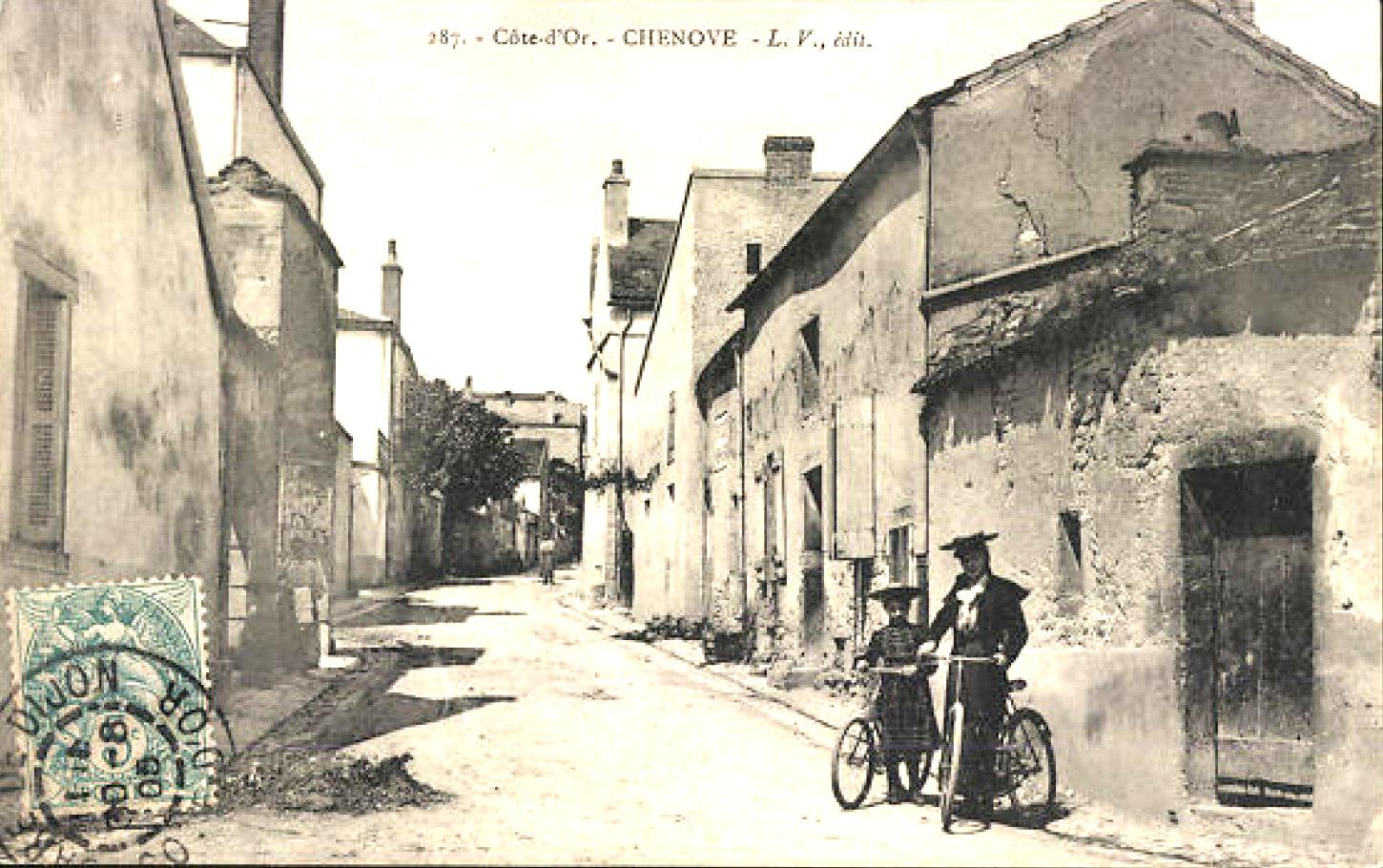
14 - History of Chenôve
Chenôve is one of the oldest villages on the Côte. Archaeological discoveries (aerial photographs, excavations with pottery dating) confirm that Chenôve has Gallo-Roman origins, possibly dating back to the late Bronze Age.
The name Chenôve is thought to derive from *cannabium*, hemp, a plant cultivated in the region until the Middle Ages, a word that is believed to have evolved over the centuries into *canavae*, *canavis villa*, *chenave*, and finally *chenôve*.
From Village to Town – The Evolution of Chenôve
A wine-growing village until the early 20th century, Chenôve was then surrounded by vineyards, orchards, and market gardens. In 1901, the village had 791 inhabitants.
The arrival of the railway and the SNCF workshops in the 1920s led to the development of a new district in the plain: Chenôve-le-Bas. The population grew from 1,000 inhabitants in 1920 to 5,000 in 1960. Chenôve became a small railway town.
The Jules-Ferry school was built in 1931, followed by the Paul Bert school in 1938. The latter closed its doors in June 2010.
Construction of the Priority Urbanization Zone (ZUP) began in 1960. Chenôve thus met the housing needs of the Dijon metropolitan area and became a town. The space between Chenôve-le-Bas and Chenôve-le-Haut was filled with apartment buildings and an industrial zone.
Chenôve's population grew from 5,000 to over 20,000. This urbanization completely transformed the landscape of Chenôve, which had 400 hectares of vineyards at the beginning of the 20th century but now has only about 65.
PAUL BERT STREET – VILLAGE ARCHITECTURE
Until 1919, it was called "Mountain Street." Its architecture is typical of wine-growing villages.
- Gable-end facing the street: openings in the facades (former entrances to cellars, wine stores, vat rooms, barns, and stables)
- Bollards along the sides of the street: these are cart bollards or wheel guards that served to protect the walls from impacts caused by cart hubs
- Stone gutters, restored in the old style
- Stone walls with coping stones
- Almost all the buildings were constructed with stone extracted from the quarries located at the top of Paul Bert Street and on the plateau.