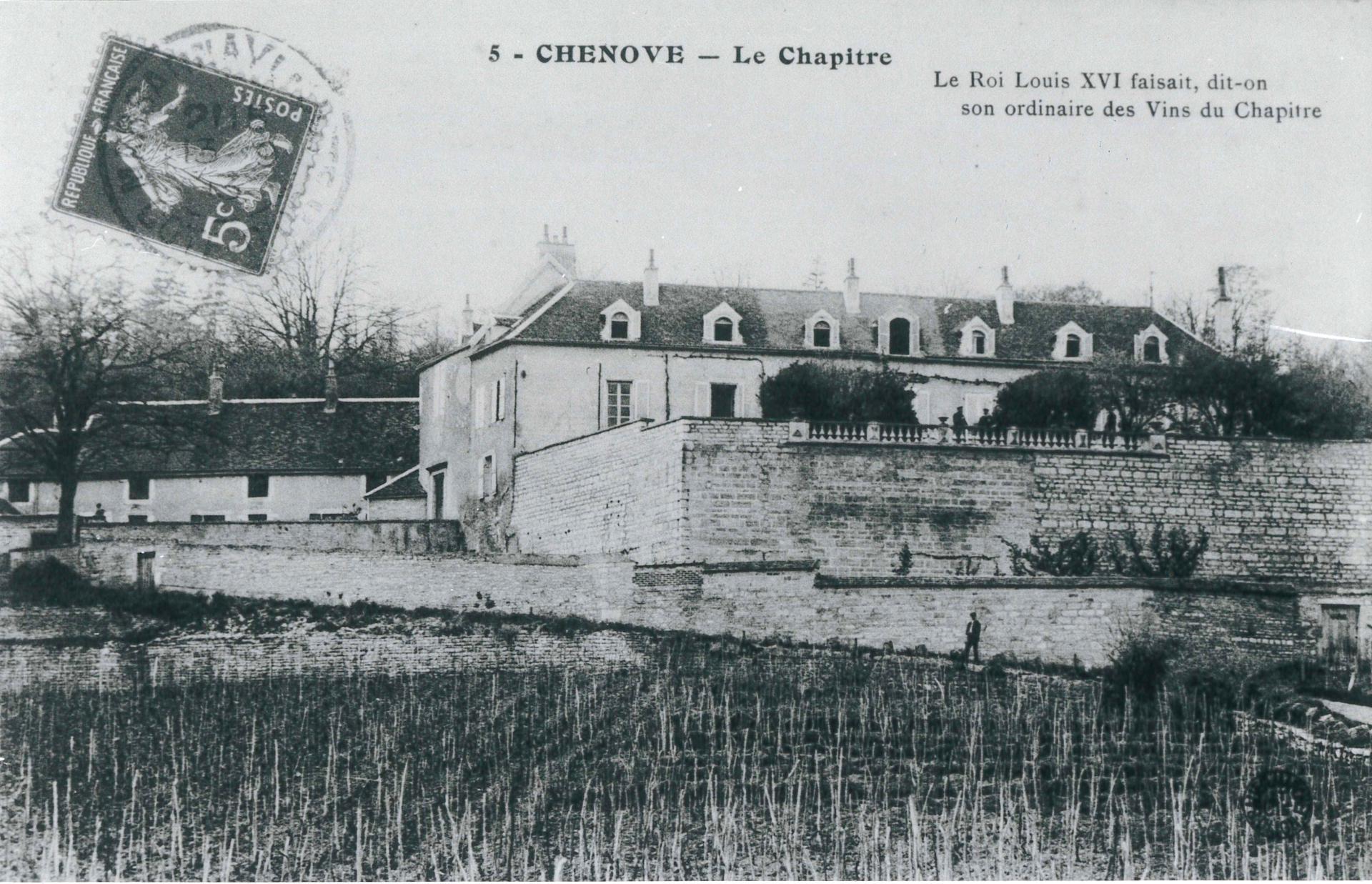
19 - The Chapter
The Chapter House is the manor house in Chenôve that served as the residence of the Canons of Autun.
The Chapter House's origins date back to 653. Saint Léger, Bishop of Autun, drew up a will in which he bequeathed his property in Chenôve to the Canons of the Chapter of Autun, on the condition that they establish a house there and cultivate the land. In 660, they erected a building made of wattle and daub (on the site of the current marble works). This building is believed to have been destroyed in 888 during the Norman invasion.
For added security, they decided to rebuild a fortified house at the top of the hill, a castle-like structure surrounded by moats and comprising several buildings (cellars, wine presses, chapel). An underground passage was dug to allow the Canons to reach the church in peace and quiet. The last vestiges of the feudal era have almost entirely disappeared. What remains today dates primarily from 1750-1800.
The vineyards and lands surrounding the Chapter house occupy a significant portion of the commune's territory. The vines of the Clos du Chapitre produce a very good wine (a wine presented to Louis XIV during his visit to Dijon, and one that Louis XVI drank regularly!). The Chapter house thus had a strong winemaking tradition, but for a very long time it also housed a prison. The Canons held the right of high, middle, and low justice, and the mayor or church official of Autun pronounced the sentences. Capital executions took place in the village square.
After the French Revolution, in 1791, the Chapter house and all its properties were sold.
During the Second World War, the Germans occupied the Paul Bert town hall and school, and classrooms were set up there.
Today, the Chapter house remains private property and is not open to the public.